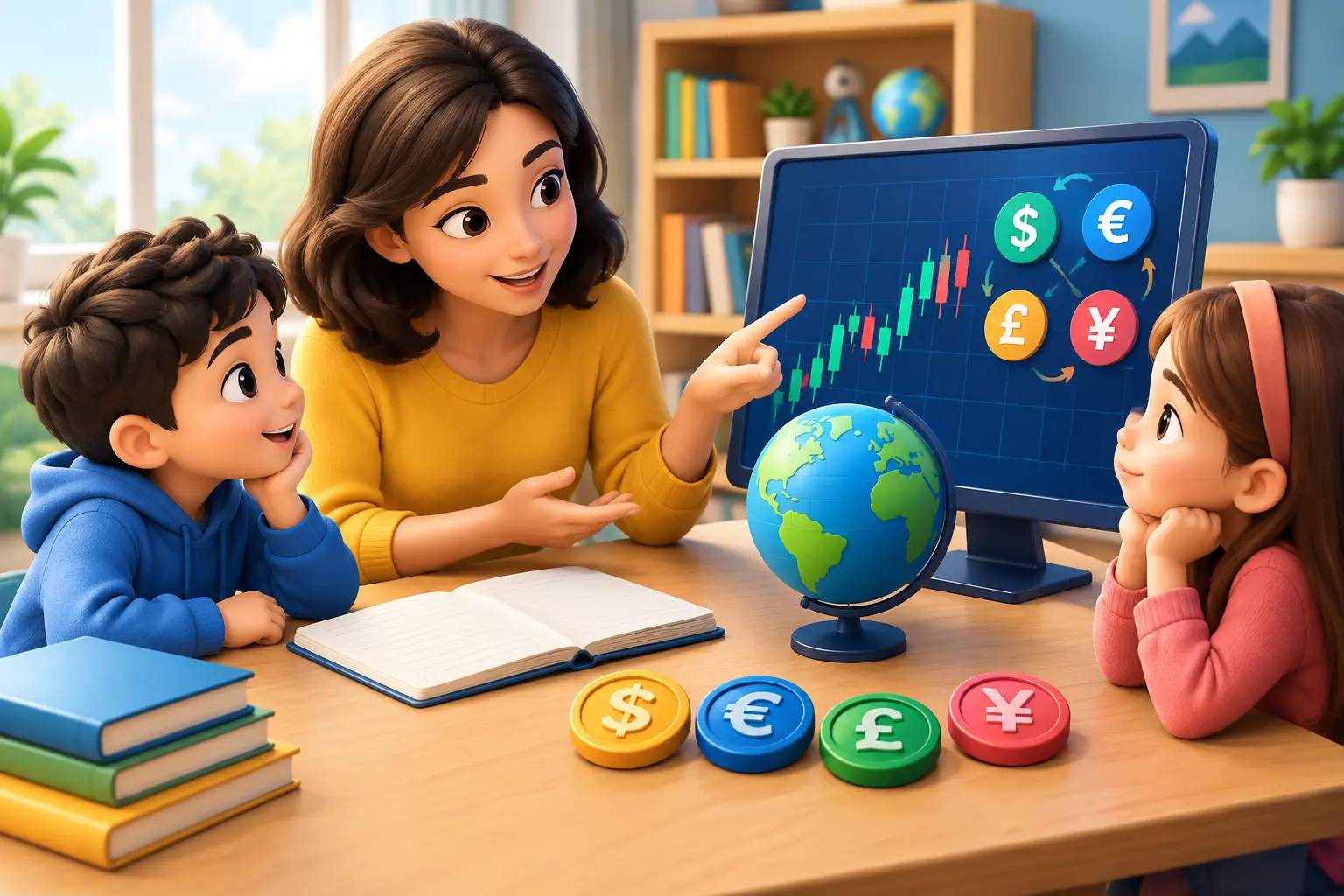
A vacation souvenir can make foreign exchange feel real: a child sees that a $10 bill may buy a different number of euros, yen, or pesos depending on where you are. That simple question - “Why is this money worth something different?” - is a better starting point than charts, predictions, or trading talk. When considering how to explain forex to kids, begin with currency as something people use every day, then add the idea of changing values slowly and carefully.
Forex can be an interesting part of financial education, but it should not be a child’s first money lesson. Earning, saving, budgeting, and setting goals come first. Foreign exchange introduces uncertainty, fast-moving prices, and global events. Children can learn what those things mean without being encouraged to take risks or chase a profit.
What is forex in kid-friendly terms?
Forex is short for foreign exchange. It is the process of exchanging one country’s money for another country’s money. If your family visits Japan and trades U.S. dollars for Japanese yen, that is a real-world example of foreign exchange.
You can explain that each country usually has its own kind of money. In the United States, people use dollars. In Canada, people use Canadian dollars. In Europe, many countries use euros. Because these currencies have different values, the amount of one currency you receive for another can change.
A simple way to say it is: “Forex is the marketplace where currencies are exchanged.” Keep the word marketplace familiar. Like prices at a grocery store, currency values move. The difference is that the “price” being discussed is the value of one kind of money compared with another.
Avoid presenting forex as a shortcut to making money. Adults who trade currencies can lose money quickly, even when they have experience. For children, the goal is understanding how the world works, not learning how to place a trade.
Why do currency values change?
Children do not need an economics lecture to understand the basic idea. Start with supply, demand, and confidence. If many people and businesses want a country’s currency, its value may rise compared with another currency. If fewer people want it, its value may fall.
You might use a trading-card analogy. If many kids want one rare card, its value can increase. If interest fades or more copies appear, its value can drop. Currency is much more complicated than a trading card, of course, because whole countries, businesses, banks, travelers, and governments are involved. But the comparison helps children understand that value can change when demand changes.
It also helps to say plainly that no one can know every reason prices will move. News, interest rates, world events, and business activity can all affect currencies. That uncertainty is exactly why forex belongs behind parent guidance and learning controls.
How to explain forex to kids with an everyday example
Try this conversation at home:
“Imagine we have $20 and are traveling to another country. We need to exchange our dollars for that country’s money so we can buy lunch. One day, our $20 might exchange for 2,000 units of that money. On another day, it might exchange for 1,900 units. We still have the same $20, but the exchange rate changed.”
Then ask a practical question: “If we get fewer units of the other currency for our $20, will our vacation spending power feel bigger or smaller?” Let your child reason it out. The answer may depend on the prices in that country, which is a useful reminder that exchange rates are only one part of the picture.
For older children, introduce currency pairs. Forex prices are usually shown as two currencies together, such as U.S. dollars and Canadian dollars. Explain that a pair answers one question: “How much of one currency does it take to equal one unit of another?” There is no need to memorize symbols or analyze a chart.
Keep the lesson grounded in money basics
Forex can sound exciting because prices may change quickly. That is also why it can distract from the habits children need most. Before discussing practice investing or market movements, make sure your child understands where money comes from and where it goes.
Connect the lesson to familiar routines. A child earns a reward for completing agreed-upon chores, saves part of it toward a goal, and decides how much is available to spend. That sequence builds ownership and patience. It also makes a later lesson about investment risk more meaningful: money used for a goal next month should not be treated the same way as money set aside for long-term learning.
When children understand that every dollar has a job, they are less likely to see market activity as a game of guessing. Forex can then be framed accurately as one example of a market where prices change and risk is real.
Use simulation, not real money
A child does not need a brokerage account, a currency exchange app, or access to live trades to learn this concept. A paper activity or educational simulation is enough. Everything should be simulated for learning, with no real money at risk.
You can create a simple family exercise. Choose two pretend currencies and an exchange rate, such as 1 home dollar equals 2 travel coins. Give your child 20 home dollars to exchange. Later, change the rate to 1 home dollar equals 1.5 travel coins and ask what changed. The point is not to reward the child for guessing the next rate. The point is to notice that changing prices affect choices.
A good simulation also creates room for reflection. Ask, “What information would we need before exchanging money?” A child may mention a trip, a purchase, or the current rate. Explain that adults also consider fees, timing, and their actual needs. They do not need to make an exchange simply because a number moved.
Trading Alchemist Adventure follows this safety-first approach by keeping learning and practice investing simulated. Parents control access to higher-risk topics, including forex, while children build the basics first.
Set clear guardrails before discussing forex
Parents do not need to make every financial topic available at once. In fact, waiting is often the responsible choice. A child who is still learning to distinguish wants from needs may benefit more from a budgeting lesson than a lesson about global currency markets.
If you decide to introduce forex, establish a few family rules in plain language. Forex is a learning topic, not a way to earn spending money. No real-money trades are made by children. A parent decides when the topic is available and stays involved in the conversation. And a changing price is never proof that someone can predict what happens next.
These boundaries matter because children may encounter videos or games that make fast trading look easy. Help them recognize the missing parts: losses, fees, uncertainty, and the emotional pressure of watching prices move. “Exciting” and “wise” are not the same thing.
Match the explanation to your child’s age
For younger school-age children, focus on travel and exchanging money. They can understand that different places use different currencies and that the exchange amount can vary.
For older children, add the idea that businesses also exchange currencies when they buy and sell things across borders. You can discuss why a company importing products might care about changes in exchange rates. This makes forex less mysterious and less centered on speculative trading.
Teens who already show consistent saving and budgeting habits may be ready to explore market data in a supervised simulation. Even then, treat the activity as observation and decision practice. Ask them to explain the risk before they explain a possible gain. If they cannot describe what they might lose or why prices move, slow down.
Questions kids may ask about forex
“Can people make money from forex?”
Some adults try to profit from currency changes, but many also lose money. Forex is not predictable, and it can move very quickly. That is why children should learn about it through supervised, simulated activities rather than real trades.
“Why can’t we just wait for the best exchange rate?”
Sometimes families need another currency for a practical reason, such as travel or paying for something abroad. Waiting may help, hurt, or make no meaningful difference. The best choice depends on the family’s needs, not on trying to guess every price movement.
“Is one currency better than another?”
Currencies are tools people use in different places. Their values change relative to each other, but that does not make one country’s people or money “better.” The useful question is what a currency can buy and why someone needs to exchange it.
A calm, honest forex lesson teaches more than currency conversion. It shows children that money decisions involve context, uncertainty, and patience. Keep the conversation connected to their real life, keep higher-risk topics under parent control, and let strong everyday habits lead the way.