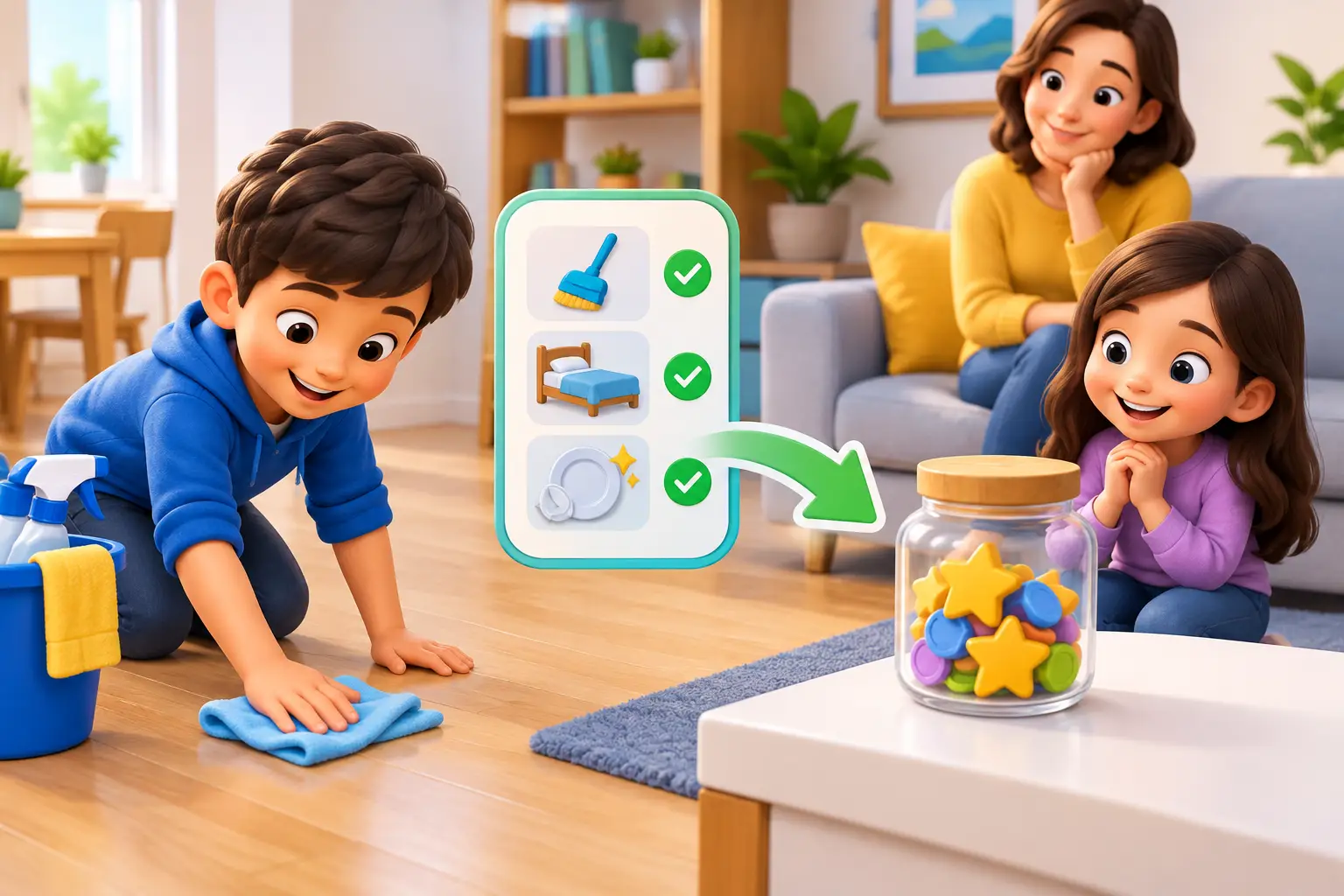
A reward system can fall apart fast when a child feels they are being paid for every small request, or when a parent has to negotiate each task at the end of the day. The answer is not bigger rewards. It is a clearer connection between effort, choices, and goals. Learning how to link chores rewards gives children a practical first lesson in earning while keeping the parent in charge.
The goal is not to turn your home into a workplace. It is to help children see that money has a source, decisions have trade-offs, and progress toward a goal takes consistency. Start with household expectations, then add a simple earning structure that fits your child’s age and your family’s values.
Start by separating family responsibilities from paid chores
Not every chore should come with a reward. Children are part of the household, so basic responsibilities can remain unpaid. Making the bed, putting dirty clothes in the hamper, clearing a plate, and keeping a bedroom reasonably tidy are examples of contributions that support family life.
Paid chores work best when they are clearly extra. They might include washing the car, organizing a storage area, helping with yard work, sorting recycling, or taking on a larger cleaning task. The exact jobs matter less than the boundary: your child should understand that some responsibilities are expected because they belong to the family, while additional effort can create an opportunity to earn.
This distinction prevents a common problem. If every routine task earns money, children may begin to see basic cooperation as optional. If nothing earns money, they lose a useful chance to practice the connection between work and income. A balanced system makes room for both.
How to link chores rewards to real goals
A chore chart alone teaches task completion. A chore-and-reward system can teach more when the reward has a purpose. Instead of handing over a small amount and ending the conversation, help your child decide where their earnings will go.
For younger children, that may mean dividing earnings among spending, saving, and sharing. For older children, it may mean setting aside money toward a game, sports equipment, a gift, or a larger family goal. The amounts can be small. What matters is the repeated practice of choosing.
Give the goal a name and a visible progress marker. A child saving for a $30 item can see that three completed chores at $2 each moves them from $6 to $12. That is more meaningful than hearing a general reminder to save money. They can see the gap, calculate what remains, and decide whether they want to keep earning or wait.
Avoid making every reward cash. Extra screen time, choosing Friday’s movie, selecting dessert, or inviting a friend over can work for some families. However, money-based rewards are especially useful when your goal is financial education because they create natural opportunities to discuss saving, budgeting, and delayed gratification.
Make the rules visible before the work begins
Children are more likely to stay engaged when the system is predictable. Decide together what counts as completing a chore, how much it is worth, and when rewards are recorded. A vague agreement such as “help more around the house” invites disagreement. A specific agreement is easier to follow.
For example, “Clean the bathroom” may mean wipe the counter, clean the mirror, empty the trash, and sweep the floor. If the standard is age-appropriate and visible, your child knows what success looks like. You are no longer judging a surprise standard after the fact.
Keep the first version simple. Choose a short list of available paid chores and set a review time, such as Sunday evening. Weekly reviews reduce daily bargaining and give children time to see patterns. Did they finish the work they chose? Did they move closer to their goal? Do the chores or reward amounts need to change?
Consistency matters more than precision. You do not need to calculate a perfect market rate for folding laundry. Choose amounts that feel sustainable for your family budget and proportionate to the work. If a reward is too large, the system can become expensive and distracting. If it is too small to feel meaningful, children may not connect effort with progress.
Use rewards to teach choices, not just compliance
The most valuable conversations happen after a reward is earned. Ask your child what they want their money to do next. If they want to spend all of it immediately, resist the urge to turn that moment into a lecture. Ask what they are giving up by spending now and whether their larger goal still matters to them.
This is where budgeting becomes real. A budget is simply a plan for limited money. Children do not need complex spreadsheets to understand it. They need repeated, low-stakes chances to decide: spend now, save for later, or reserve part for something else.
It also helps to let children experience manageable consequences. If they spend their reward on a small item and later wish they had saved it, that disappointment can become a useful lesson. You can be supportive without replacing the money or changing the rule. Real financial decisions will eventually involve trade-offs. Practicing them at home is safer.
Keep parent oversight at the center
A reward system should support your family, not create pressure or confusion. Parents should decide which chores are available, what rewards make sense, and which financial topics are appropriate. This is especially important as children become curious about stocks, cryptocurrency, or quick ways to make money.
Money basics and practice investing come first. Children benefit from understanding earning, saving, goals, and risk before they explore more advanced topics. Any investing activity should be educational and simulated, not a pathway to real transactions, external accounts, or live trading.
Trading Alchemist Adventure follows this progression by connecting chores and rewards to saving, budgeting, financial literacy lessons, and practice investing using real market data. Everything is simulated for learning. Parents maintain control over access, including higher-risk subjects, while children can build confidence through guided decisions rather than real-money exposure.
What if one child earns more than another?
Different ages and abilities can make equal rewards impractical. Fair does not always mean identical. A younger child may earn from shorter, simpler tasks, while an older child takes on responsibilities that require more time or skill.
Explain the reason for the difference plainly. The goal is not to rank children. It is to match the task and reward to what each child can reasonably do. You can also offer shared family projects with a group reward, such as a game night choice after everyone helps prepare the yard or organize a common space.
Be careful about using rewards to compare siblings. “Your sister earned more because she worked harder” may create resentment rather than motivation. Keep the focus on each child’s own commitments, progress, and goals.
What if chores become a constant negotiation?
Negotiation usually signals that the rules are too broad, too frequent, or not written down. Return to the basics: unpaid household responsibilities, a limited menu of paid extra chores, clear completion standards, and one regular review time.
You can also pause a system that is causing more conflict than learning. Tell your child why: the family needs a structure that feels respectful and workable for everyone. Then restart with fewer chores and simpler choices. A smaller system that you can maintain is better than a detailed chart no one wants to use after two weeks.
Do not use earned rewards as a threat during unrelated conflicts. If a child completes an agreed chore, record the reward. Behavior issues, safety rules, and privileges can be handled separately. Keeping those categories clear protects trust in the earning system.
A simple first-week plan
Begin with one unpaid daily responsibility and two optional paid chores. Set one reward amount for each paid chore, choose a savings goal together, and agree on a weekly check-in. At that check-in, record what was earned and ask your child to decide how much to save, spend, or hold for later.
That is enough to begin. You can add lessons about budgets, market risk, and investing practice as your child shows readiness. The strongest money habits rarely come from one big conversation. They grow through small, repeatable decisions made with a parent nearby to guide the next step.