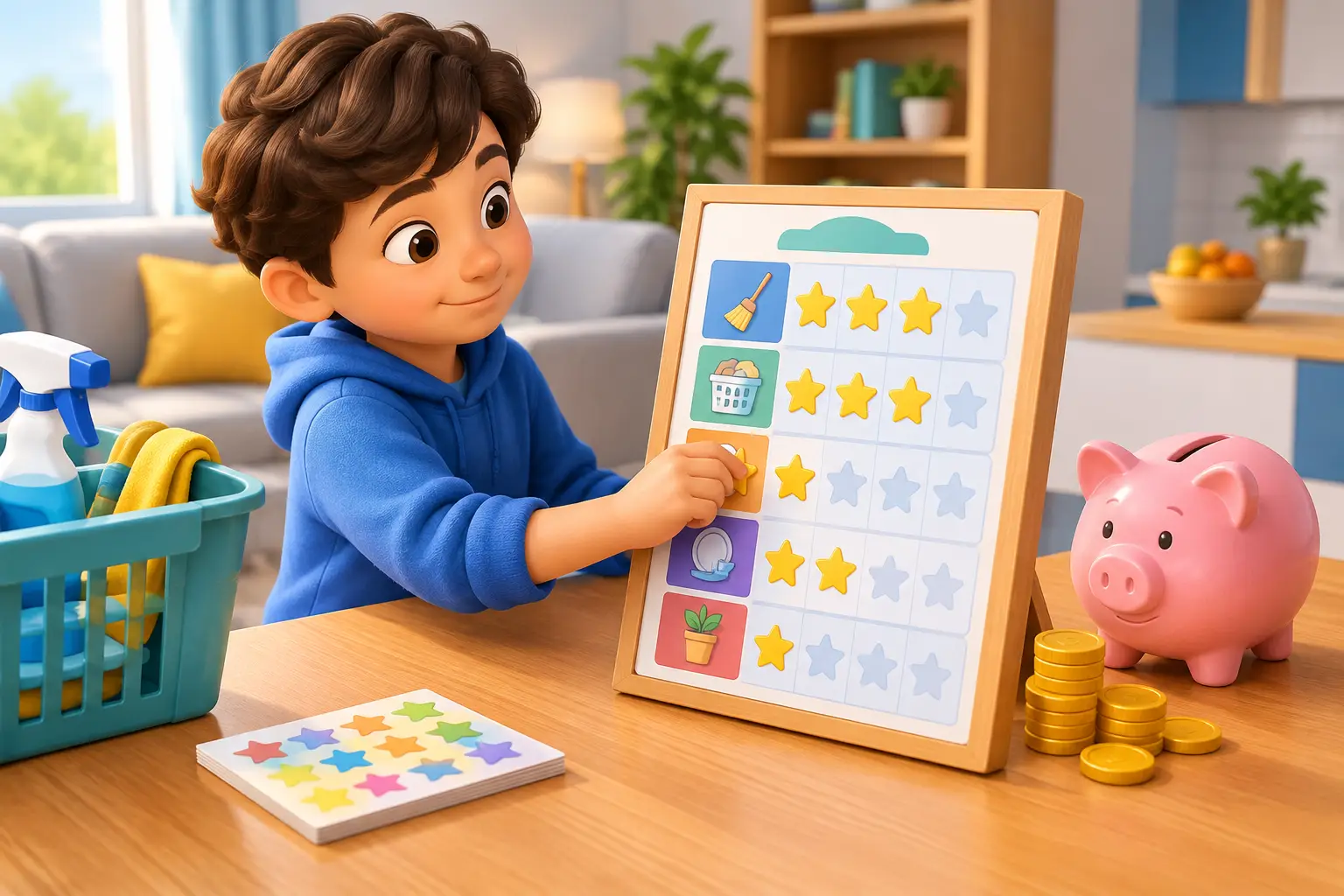
A chore chart is often treated as a way to get help around the house. It can be much more useful than that. When children can see what they are responsible for, what they earn, and what happens next with that earning, everyday tasks become a practical lesson in money choices.
The goal is not to turn family life into a workplace or make children feel paid for every helpful act. The goal is to create a clear, parent-guided routine: contribute, earn, plan, and make thoughtful choices. That routine gives money concepts a place in real family life, long before a child is managing a bank account or making real investment decisions.
What should a chore chart teach?
A useful chart teaches more than task completion. It helps children connect effort with earning and earning with responsibility. A child who earns a reward for feeding the dog or organizing a backpack can begin to understand that money is a limited resource, not simply something that appears when they want something.
From there, the next lessons matter just as much. If every reward is immediately spent, the chart teaches earning but misses saving and planning. A stronger approach gives children a simple path after they earn: set aside some for a goal, decide whether to spend some now, and learn that choices involve trade-offs.
For younger children, this may mean choosing between a small treat this week and a larger item later. For older children, it can include a basic budget, a savings goal, and a conversation about how investments can rise and fall over time. The pace should fit the child, but the sequence stays steady: earn first, then save and budget, then practice investing.
Should every household task be paid?
Usually, no. Children benefit from learning that some responsibilities come with being part of a family. Making a bed, clearing a plate, putting away personal belongings, and helping with shared spaces can be expected contributions rather than paid jobs.
A chore chart works best when it separates regular responsibilities from optional earning opportunities. Regular responsibilities build accountability. Extra jobs, such as washing the car, helping sort a garage, raking leaves, or doing a larger organizing project, can provide a chance to earn.
There is no single rule that fits every household. Some parents prefer a weekly allowance tied to consistent participation, while others only reward completed extra tasks. Either can work if expectations are clear. Problems tend to start when rewards are unpredictable, chores are vague, or a child cannot tell why they did or did not earn something.
How to set up a chore chart that children can follow
Keep the first version simple enough that a child can understand it at a glance. Too many categories, rules, and changing rewards can make the system feel like another assignment rather than a helpful routine.
Start by choosing a short list of age-appropriate responsibilities. Be specific about what “done” means. “Clean your room” is broad; “put dirty clothes in the hamper, place books on the shelf, and clear the floor” gives a child a fair standard to meet.
Then decide which tasks are family responsibilities and which are earning opportunities. Set a reward before the task begins, not after. This protects both the child and the parent from a last-minute negotiation about whether the work was worth more.
Finally, choose a consistent review time. A quick check each evening may work for younger children. Older children may do better with a weekly review that includes chores completed, rewards earned, savings progress, and upcoming goals. Consistency matters more than perfection. If a week gets busy, restart the routine without turning it into a lecture.
Make the reward part of the lesson
A reward can be money, points, screen-time privileges, a family activity, or another agreed-upon benefit. Money rewards are especially useful when the family wants to teach budgeting, but the amount does not need to be large. A small, regular amount gives children practice making choices without high stakes.
Consider asking your child to divide an earned reward into simple categories: spend, save, and give, if giving is part of your family values. The percentages do not need to be rigid. A child saving for a meaningful goal may choose to save more for a while. What matters is that they see a plan and understand why they made it.
Avoid using a chore reward to cover necessities that parents are already responsible for providing. Children should not worry that food, school supplies, or basic care depend on whether they completed a task perfectly. A chore chart should build confidence, not create pressure around essential needs.
Use goals to make saving feel real
Saving is easier for children when it is connected to something they can name. Instead of saying, “You should save more,” help them identify a goal, estimate its cost, and see how each completed chore moves them forward.
A visible progress tracker can help, especially for younger children. Older children may be ready to compare options. If they want a new game, for example, they can decide whether to buy it as soon as they have enough or wait for a different goal that matters more. That is budgeting in a form they can understand.
Parents should guide the conversation without taking over every decision. It is fine for a child to make a small choice they later regret. Spending all of a reward and realizing a goal now takes longer can be a useful lesson when the consequences are manageable. The parent’s role is to help them reflect, not to shame them.
Where does practice investing fit in?
Practice investing should come after a child understands basic earning, saving, and budgeting. A stock chart may look exciting, but it is not a replacement for money fundamentals. Children need to understand that investing involves risk, changing values, and a longer time horizon.
This is also where clear boundaries matter. Learning about the market does not require a child to use real money, connect an external financial account, or place live trades. Everything can be simulated for learning. A child can observe real market data, make practice decisions, and see possible results without financial exposure.
Trading Alchemist Adventure is designed around that sequence. Parents can connect chores and rewards to saving, goals, financial lessons, and simulated investing while keeping control of the learning path. Higher-risk topics, including cryptocurrency and forex, should remain behind parent-controlled access settings rather than appearing as casual entertainment.
How much parent involvement is enough?
Children need ownership, but they also need oversight. A seven-year-old may need help reading the chart and deciding how to divide a reward. A middle schooler may be able to track tasks independently but still benefit from a weekly conversation about goals and choices.
The right level of involvement depends on age, maturity, and the complexity of the system. Start with more structure, then give more independence as your child shows they can handle it. Parents should always retain control over rewards, settings, and access to more advanced financial topics.
It also helps to keep conversations calm and factual. If a chore was missed, address the task and the agreed result. If a savings goal changed, talk through the new plan. A chore chart is not meant to settle every family conflict. It is a predictable framework that reduces confusion and gives children repeated chances to practice responsibility.
Common chore chart problems and simple fixes
If the chart is ignored, it may be too complicated or placed where no one sees it. Reduce the number of tasks and review it at a regular family moment. If children argue about fairness, check whether tasks match each child’s age and whether the reward rules were explained in advance.
If rewards are becoming the only reason a child helps, reinforce the distinction between family responsibilities and extra earning opportunities. If a child loses interest after reaching a goal, help them choose a new one or shift the focus to a bigger skill, such as planning a month of spending.
The most valuable chore chart is not the prettiest one or the one with the most tasks. It is the one your family can use consistently, with clear expectations and room for children to learn from both progress and mistakes.